Security
Security that travels with the data
Permissions are enforced on every read and every Action: in applications, exports, documents, BI feeds and AI prompts alike. There is no unguarded path to the data.
Security architecture
| # | Control | How DCAS does it |
|---|---|---|
| 1 | Tenant isolation | Each organisation’s rows are separated by PostgreSQL row-level security, forced on every tenant table. The database itself refuses another organisation’s data. |
| 2 | Identity | Short-lived signed tokens (RS256). The engine holds only the public key, so it cannot mint access for anyone. Two-step sign-in, single sign-on (OpenID Connect) and smart cards. |
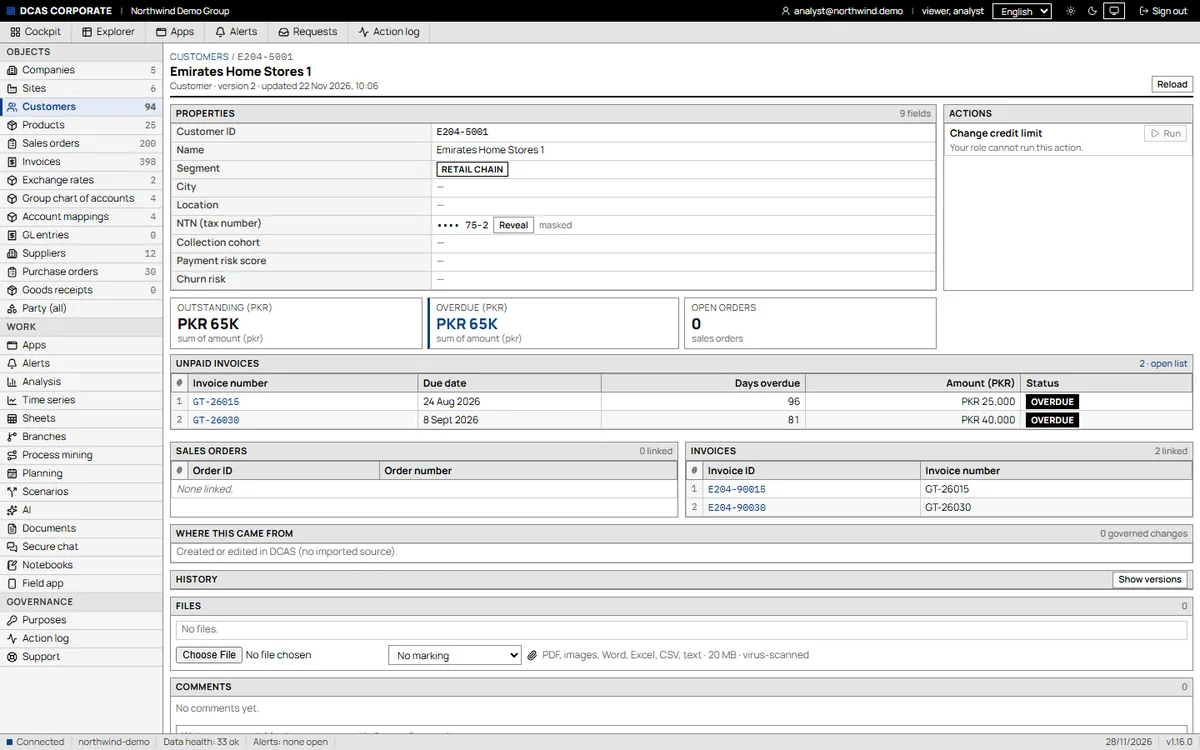
| 3 | Markings | Fields and records carry markings such as finance or HR. People without the marking never see the value, cannot filter or sort on it, and it never appears in exports, documents, BI feeds or AI prompts. |
| 4 | Purpose-bound access | Sensitive data can require a stated, approved purpose that expires. Every justification is recorded. |
| 5 | Protected fields | Masked or encrypted fields with a justified reveal, logged each time. |
| 6 | Governed actions | Every change goes through an action with checks; sensitive actions need approval, some by two people. |
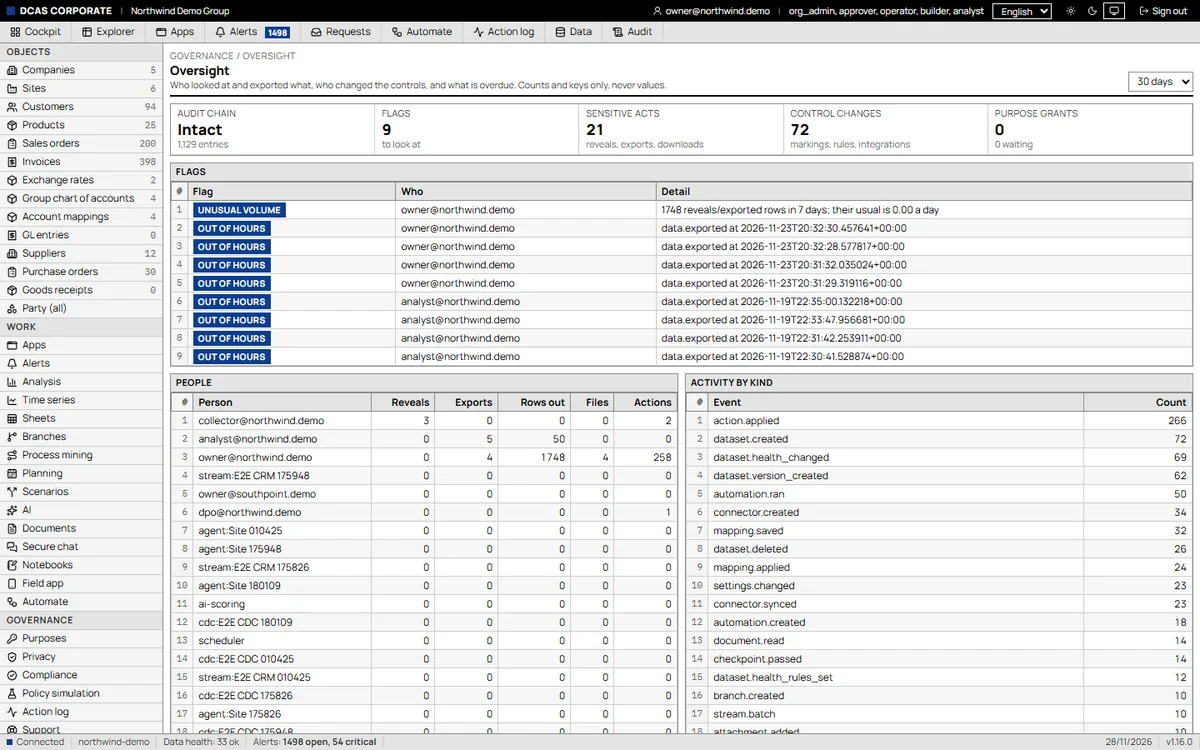
| 7 | Audit trail | A hash-chained log of every action, export and reveal. Tampering breaks the chain, and the chain is verified after every restore. |
| 8 | Aggregate-only roles | Statisticians and partners can see totals only, with small cells suppressed so individuals cannot be singled out. |
| 9 | Policy simulation | See exactly what a person would see before you give them a role. |
| 10 | Uploads | Files are virus-scanned, limited to safe types, encrypted at rest, and served so a browser cannot run them. |
| 11 | Notebook sandbox | Python runs in a separate service with no network, no secrets and a read-only file system. |
Privacy and compliance
- Retention rules, legal holds, and four-eyes deletion that leaves a tombstone.
- Data-subject requests: find, export and erase a person’s data across the model.
- A sensitive-data scanner that flags personal data in new datasets.
- A compliance evidence pack generated on demand for auditors.
- An auditor role with an oversight dashboard, and no power to change data.
AI under the same rules
- Models are reached only on hosts you allow, and local models come first.
- A model sees only fields it has been cleared for; every prompt and answer is logged.
- Agents propose; people approve. No AI output changes data on its own.
- Training on your data is off by default; when allowed, marked and personal fields are left out.
Adversarial testing
Every release is tested end to end, including attempts to break the rules: another organisation reading by id, people without a role calling admin functions, forged and expired tokens, injection, inference of hidden fields, requests to internal addresses, stored scripts, unsafe uploads and sandbox escapes.
The November 2026 internal penetration test ran 113 probes across 15 areas against version 1.16. All of them passed once the issues it found were fixed. A summary of the report is available to prospective customers on request.
Production baseline
| Containers | Non-root, read-only file systems, all capabilities dropped |
|---|---|
| Network | Default-deny between services; only the edge faces users |
| Releases | Signed bundles; packs must be signed to load |
| Errors | Generic error pages, no version numbers in headers |
| Backups | Encrypted, with a restore drill that verifies the audit chain |
| Patching | Security advisories tracked per install by the fleet hub |
Report a vulnerability
Write to security@silicatelabs.site. We reply within two working days, and we do not take action against good-faith research that respects other people’s data. Our security.txt has the details.
Talk to us about your security requirements
We can walk your security team through the architecture and the test report.