Platform
One platform. From raw data to executed decision.
DCAS is a single, integrated platform. Every capability runs on the same Ontology and the same security model, so each new use case compounds the value of the last.
Data Integration
| # | Capability | What it delivers |
|---|---|---|
| 1 | ERP connectors | Read-only connectors for SAP (OData and CDS views), Oracle EBS, PostgreSQL, MySQL, SQL Server and Oracle, with ready templates for common ERP tables. |
| 2 | Uploads | CSV and Excel import with a mapping wizard, so departments that live in spreadsheets are not left out. |
| 3 | Mapping and reconciliation | Map each source’s fields and codes to the shared model: value maps, date and number transforms, currency conversion, group charts of accounts. Reconcile totals against the source. |
| 4 | Health checks | Freshness, row counts and schema checks on every dataset, with alerts when a feed goes stale. |
| 5 | Pipelines and contracts | Multi-step pipelines with data contracts that block bad data before it reaches the model. |
| 6 | Streams and change capture | Live events with rules that fire as data arrives; change capture from source databases. |
| 7 | On-site agent | A small agent inside a plant or branch network pushes data out, so no inbound firewall rule is needed. |
| 8 | Entity resolution | Finds the same customer or supplier across systems and links them, with review of uncertain matches. |
| 9 | Catalogue and lineage | Every dataset described and searchable; every value traceable to the source row and the step that made it. |
The Ontology and Actions
| # | Capability | What it delivers |
|---|---|---|
| 1 | The Ontology | Object types, properties, links and interfaces model the enterprise the way operators speak about it: companies, customers, orders, invoices, plants, suppliers. Defined in signed packs. How the Ontology works. |
| 2 | Derived values and history | Values computed from others (ageing, risk bands), and the full history of every record. |
| 3 | Time series | Readings and measures over time, attached to the objects they belong to. |
| 4 | Actions | Every change is an Action, with parameters, validation and submission criteria. Sensitive Actions require approval, under four-eyes rules where needed. |
| 5 | Batch actions and write-back | Apply one decision to many records; write approved changes back to source systems. |
| 6 | Branches | Change a copy of the model safely and merge it when approved. |
Packs
Industry knowledge ships as packs: object types, actions, rules and apps for a domain. Packs are signed, and production refuses unsigned ones.
Corporate Base Pack: group structure, customers, orders, invoices, receivables, general ledger mapping.
Supply Chain Pack: suppliers, purchase orders and goods receipts, with Actions to approve orders and put a supplier on hold.
More industry packs follow with design partners.
Applications
| # | Capability | What it delivers |
|---|---|---|
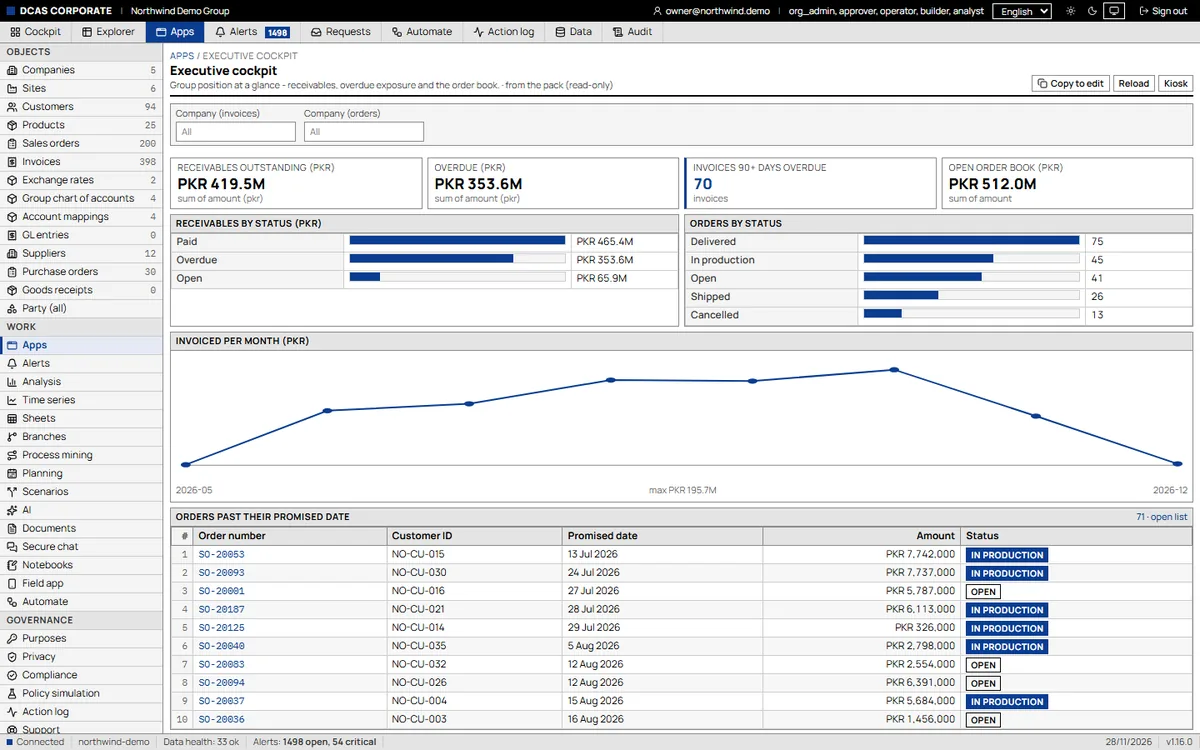
| 1 | App builder | Tables, charts, KPIs, filters, maps and action buttons, assembled without code. Apps have versions and can be rolled back. |
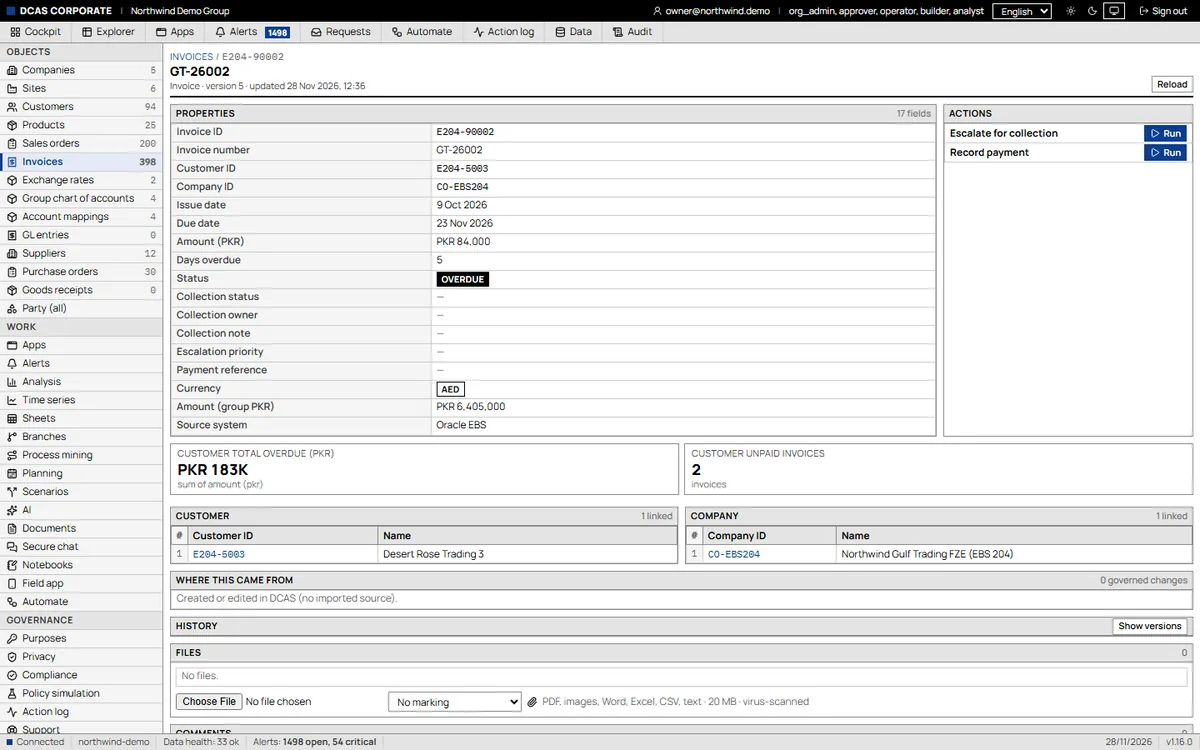
| 2 | Cockpits and record views | A cockpit per role, and a view per object type that shows what matters about one record. |
| 3 | Analysis | Pivots, timelines and Gantt charts on live data, with click-to-filter. |
| 4 | Sheets | Spreadsheets with live formulas over the model, for the people who think in Excel. |
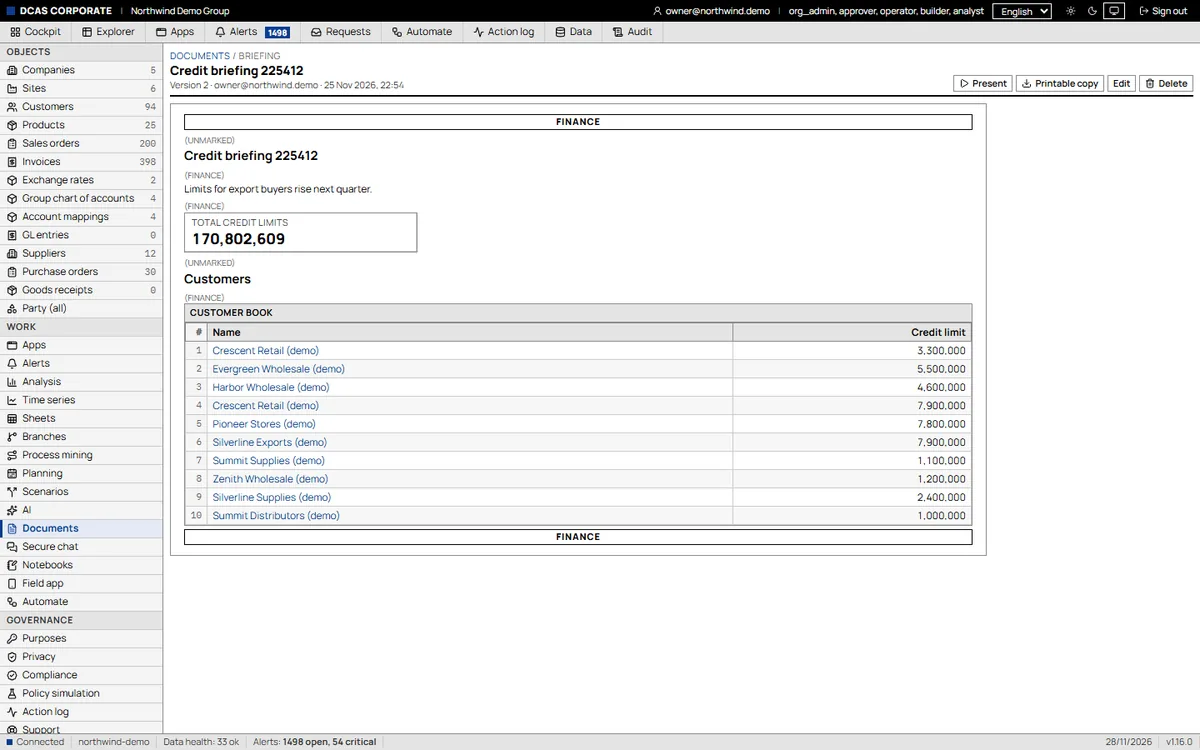
| 5 | Documents and briefings | Reports built from live data, with each section marked and redacted for the reader’s clearance. |
| 6 | Secure chat and comments | Discussion attached to records, mentions, and chat rooms with membership control. |
| 7 | Field app | Works offline on a phone or tablet and syncs when back in coverage. |
| 8 | BI access | A read-only OData feed for Power BI and Excel, within the same access rules. |
| 9 | Notebooks | Python notebooks over the model, run in a sandbox with no network. |
Operational Intelligence
| # | Capability | What it delivers |
|---|---|---|
| 1 | Rules and alerts | Threshold, per-entity, rolling-window and label rules. Backtest a rule on history before switching it on; changes to rules are reviewed. |
| 2 | Alert workflow | Assign, comment, resolve with an outcome; suggested outcomes from similar past alerts. |
| 3 | Process mining | Real paths through a process, bottlenecks, conformance to a reference path, root causes, and alerts on deviations. |
| 4 | Planning | Schedules from packs, conflicts on a Gantt chart, drag to replan, and an optimising solver whose proposals are applied only through an approved action. |
| 5 | Scenarios | What-if assumptions on a branch, propagated along links, with a KPI comparison against the current plan. |
AI, local first
DCAS works with models you run yourself (Ollama or any OpenAI-compatible server on your network), and only with hosts you allow.
- AI-backed properties, with lineage to the model and prompt that produced each value.
- Suggestions for actions, alert outcomes and data mapping. A person decides.
- Agents that only propose: their work becomes a request that a person approves.
- Evaluation sets built from real past decisions, token limits per person and organisation, and a full prompt audit.
- Marking-aware context: a model sees only what it has been cleared for. Training on your data is off by default.
Operations and Ecosystem
- A fleet hub for groups with several installs: versions, health, configuration with an audit of changes, and open security advisories per install.
- Signed releases and release channels; updates are installed by your administrator, never pushed.
- Vendor apps from third parties, signed and limited to the permissions you approve.
- Consortia: pooled, aggregate-only figures across organisations, with small cells hidden.
- A Python SDK, an MCP server for AI assistants, and developer sandboxes with synthetic data.
Developer platform
| # | Interface | What it is for |
|---|---|---|
| 1 | REST API | Every capability in the user interface is an API call first: objects, Actions, analysis, exports. The same permissions apply. |
| 2 | Python SDK | Query objects with filters and ordering, and apply Actions, from scripts and services, with a personal access token. |
| 3 | MCP server | Lets an AI assistant search objects, read them and propose Actions, inside the user’s own permissions. |
| 4 | OData feed | Read-only access for Power BI and Excel, with markings applied and every read audited. |
| 5 | Packs | Object types, Actions, rules, schedules and applications as signed YAML, versioned and installed per organisation. |
| 6 | Webhooks and write-back | Events out to your systems, and approved changes back into the source, to allow-listed hosts only. |
| 7 | Vendor apps | Third parties publish signed, declarative applications that run only within the permissions you approve. |
| 8 | Developer sandboxes | A separate organisation filled with synthetic data, for partners and in-house developers, that expires on its own. |
See DCAS on data like yours
A live demonstration on synthetic data from your industry, then a scoped Data Sprint on your own systems.